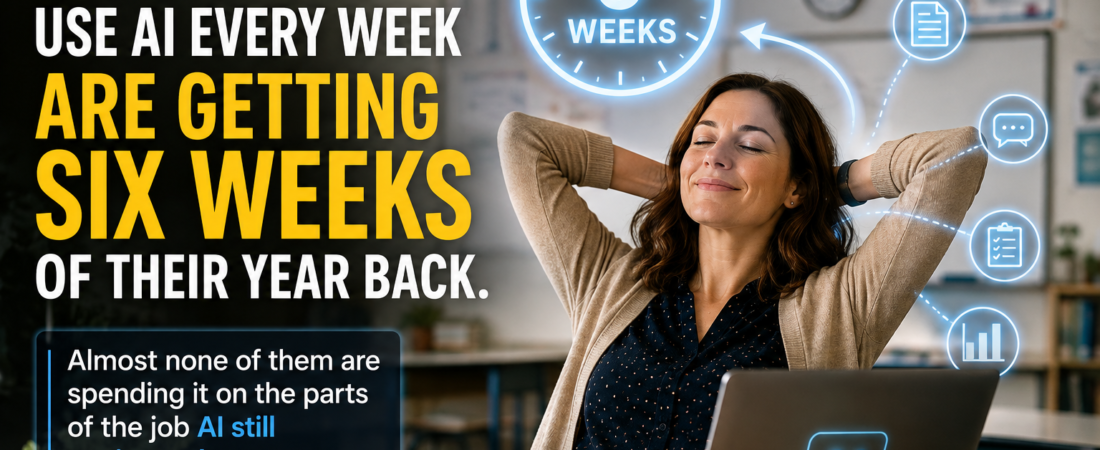
Teachers who use AI every week are getting six weeks of their year back. Almost none of them are spending it on the parts of the job AI still can’t touch.
That’s not a guess. It’s what teachers themselves report when researchers actually ask them what they use AI for, task by task, rather than just whether they use it at all. And it points to a more useful question than “will AI replace teachers” — which is which parts of teaching AI is already doing, which parts it barely touches, and why that split isn’t closing the way you’d expect.
The Job Isn’t One Thing
“Teacher” covers two very different kinds of work. One kind happens before and around the classroom: planning lessons, building worksheets, adapting materials for different students, handling paperwork, writing assessments. The other kind happens inside the classroom, in real time, with actual kids: grading and giving feedback that lands, running one-on-one instruction, reading a room and adjusting on the fly, managing behavior, building the kind of trust that makes a struggling student ask for help instead of hiding.
Two survey waves from the Walton Family Foundation and Gallup, fielded eight months apart, show teachers sorting AI into these two buckets almost by instinct — without anyone telling them to.

What Teachers Actually Use AI For
Gallup’s June 2025 survey asked teachers which tasks they use AI for at least monthly. The results line up almost perfectly with a preparation-and-paperwork pattern, not a teaching pattern. A later Gallup-Walton survey, fielded February-March 2026 with 2,069 public K-12 teachers, asked a related but separate question: how much guidance schools actually give teachers on using AI for each of those same kinds of tasks. Put side by side, the two data sets tell the same story twice.
| Task | Teachers using AI ≥ monthly (June 2025) | Teachers with no school guidance at all (Feb-Mar 2026) |
|---|---|---|
| Preparing lessons | 37% | 45% |
| Making worksheets/assignments | 33% | 47% |
| Modifying materials for student needs | 28% | 49% |
| Administrative work | 28% | 59% |
| Making assessments | 25% | 48% |
| Grading and student feedback | 16% | 58% |
| One-on-one instruction/tutoring | 14% | 69% |
Figures come from two separate Gallup-Walton Family Foundation “Teaching for Tomorrow” survey waves
(June 2025 and February-March 2026); task categories are directly comparable, though exact wording
differs slightly between waves.
The highest-adoption tasks are the ones furthest from direct student contact. The lowest-adoption task, one-on-one instruction, is also the task with the least school guidance of any measured — 69% of teachers say they’ve received no direction at all on whether or how to use AI there. Adoption and guidance are moving together, not against each other: teachers aren’t avoiding the relational tasks because they distrust AI in general — the same teachers report real quality gains elsewhere. They’re avoiding it specifically where the stakes are most personal and the rules are least clear.

AI-generated illustration
Why the Divide Holds: Time Saved, Trust Not Yet Built
The upside is real and worth taking seriously. Teachers who use AI at least weekly report saving an average of 5.9 hours a week — about six weeks over a school year — and a majority say the quality of their work actually improved where they used it: 64% say AI improved materials adapted to student needs, 61% report better insights from student data, and 57% say it improved their grading and feedback quality specifically. That last figure matters, because it means the caution around grading isn’t about AI doing it badly. It’s about something else.
That something else shows up clearly in the guidance data. Just 18% of teachers report receiving any formal, written guidance from their school on using AI for even one of ten common tasks. Another 48% get informal guidance only — a verbal norm, a shared expectation, nothing written down. A full third of teachers get no guidance on any task at all. And where guidance does exist, it rarely gives a clear answer: most teachers who do get some direction say it neither encourages nor discourages AI use, leaving the actual decision in their own hands, task by task, without institutional backing either way.

UNESCO, in its own 2025 global teacher campaign, states the institutional case for why this caution around the classroom’s relational core makes sense rather than reading as reluctance: teaching is “fundamentally relational — built on interpretation, judgment, emotional understanding, and the ability to guide learners as developing individuals,” and AI “cannot replicate the relational, ethical, and human dimensions of teaching.” That’s UNESCO’s stated position, not a measured outcome — but it matches, almost point for point, where the survey data shows teachers actually drawing the line themselves, without being told to.
The Labor Market Doesn’t Fit an “AI Replaces Teachers” Story Either
Here’s where the picture gets genuinely different from other “will AI replace X” questions.
In the United States, the Bureau of Labor Statistics projects secondary school teacher employment to decline 2% between 2024 and 2034 — a small drop against 3% average growth across all U.S. occupations — while still projecting about 66,200 openings a year, entirely from teachers retiring or leaving the field, not from job cuts. A broader category covering preschool through special education teachers shows a similar -1% projection. But BLS’s own explanation for this small decline names exactly two causes: state and local government budget pressure, and a shrinking school-age population and student enrollment. Nothing in BLS’s stated reasoning mentions AI or automation as a factor.
| Data point | Figure | Source |
|---|---|---|
| U.S. high school teachers, projected employment change 2024-2034 | -2% (vs. +3% all-occupation average) | U.S. Bureau of Labor Statistics |
| U.S. high school teachers, annual job openings (from replacement need only) | ~66,200/year | U.S. Bureau of Labor Statistics |
| U.S. preschool-through-special-education teacher category, projected change | -1% | U.S. Bureau of Labor Statistics |
| Global teacher shortfall projected by 2030 | 44 million more teachers needed | UNESCO / Teacher Task Force Global Report on Teachers |
Zoom out to the global picture and the contrast sharpens. UNESCO’s Global Report on Teachers projects the world will need 44 million more primary and secondary teachers by 2030 just to meet existing education goals — and the share of primary teachers leaving the profession globally has more than doubled, from 4.6% in 2015 to over 9% in 2022. A profession the world doesn’t currently have enough people willing to do, at a moment when the people already doing it are leaving faster than ever, is an unusual candidate for a technology-replacement narrative. Whatever is driving both of those numbers, none of the primary sources behind them point to AI as the cause.

What This Actually Means If You’re a Teacher
Not “avoid AI” — the time-savings and quality data both argue against that. The more useful move is the one the guidance-gap data points to directly: treat the tasks with real classroom stakes (grading that shapes a grade, one-on-one instruction, anything that touches a specific student’s trust) as the tasks that deserve the most deliberate, not the most automatic, use of AI — and push your school for actual written guidance on those tasks specifically, since the data shows that’s exactly where guidance is thinnest right now. For everything else — the planning, the worksheets, the paperwork — the survey data already shows most teachers have quietly figured out AI is worth using, whether or not their school has told them so.

AI-generated illustration
The Bottom Line
AI isn’t replacing teachers. It’s being absorbed almost entirely into the preparation layer of the job — planning, materials, paperwork — while the relational layer that actually defines teaching stays mostly untouched, not because AI has failed there but because teachers, largely without institutional guidance either way, are drawing that line themselves. Meanwhile, the labor-market story that would need to be true for “AI replaces teachers” to make sense — falling demand for the job — isn’t the story the data tells. The U.S. numbers move for demographic and budget reasons BLS states outright, and the global numbers point the opposite direction entirely: a worsening shortage, not a surplus. The real story isn’t a robot in front of the classroom. It’s a profession quietly automating its paperwork while the job it was always actually about stays exactly where it was.
Image Credits
Illustration 2: AI-generated via Kling — no external attribution required. Illustration 1: AI-generated via Kling — no external attribution required. – Visual 1 — Photo by Pavel Danilyuk on Pexels (Pexels License, free to use). – Visual 2 — Photo by Thirdman on Pexels (Pexels License, free to use). – Visual 3 — Photo by Pavel Danilyuk on Pexels (Pexels License, free to use). – Visual 4 (thumbnail/social use) — Photo by Vitaly Gariev on Unsplash (Unsplash License, free to use).