
Updated August 2026 — every figure below was verified or re-verified this month; the state laws and
position statements cited are current as of this run and may change.
In February 2025, a Google-backed startup announced its new AI health assistant was rolling out to ten U.S. hospital systems. Its name: “Nurse Avery.” Eleven months later, Oregon passed the first law in the country making it illegal for anything that isn’t human to use the word “nurse” at all — introduced by a state lawmaker who is himself a registered nurse. Washington and California followed with their own versions. This isn’t a hypothetical fight about some future AI takeover. It’s happening in state legislatures right now, while the U.S. government still projects the actual nursing job to keep growing faster than average through 2034. Here’s what’s real, what’s now law, and what’s still just marketing.
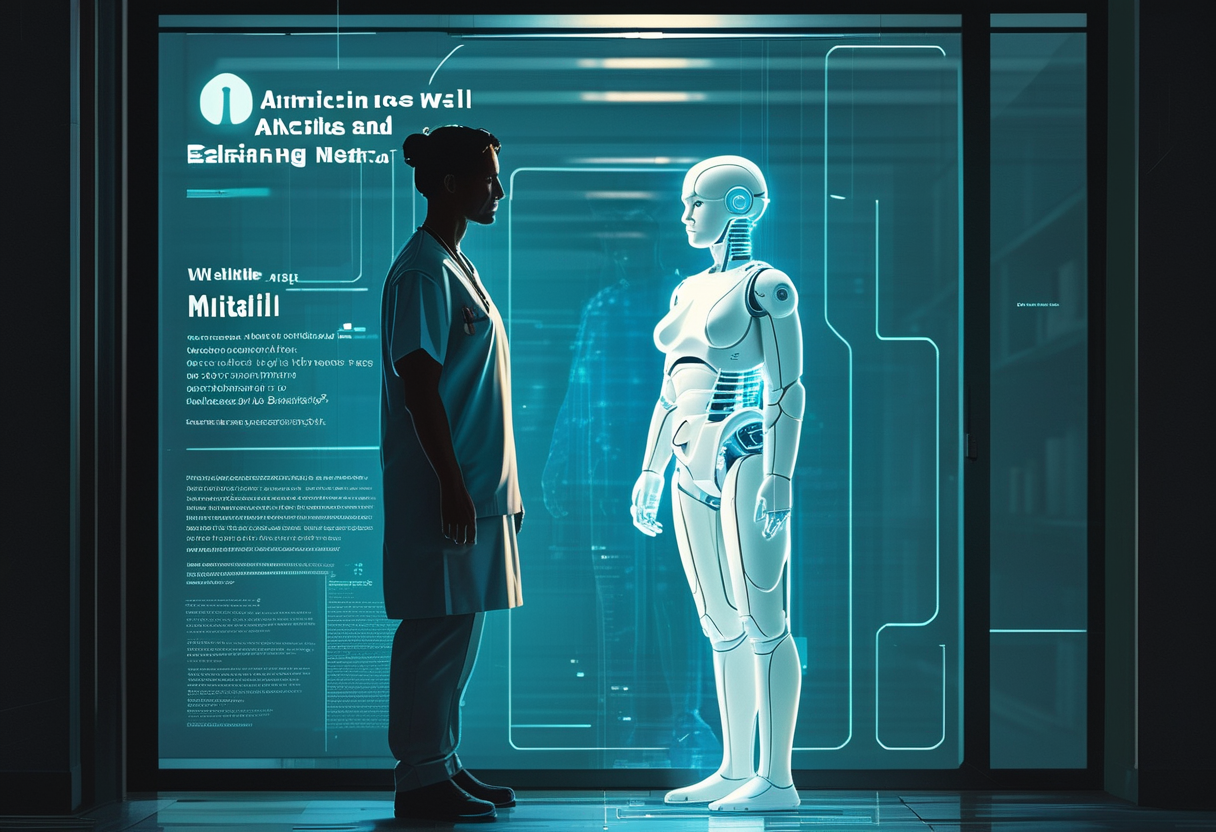
AI-generated illustration
What We Know (Fact)
Start with the baseline the rest of this piece sits on top of. The U.S. Bureau of Labor Statistics projects registered nurse employment to grow 5% from 2024 to 2034 — faster than the average for all occupations — with about 189,100 average annual openings over the decade, most from the need to replace nurses who transfer occupations or leave the workforce entirely. That last part matters more than it sounds: the National Council of State Boards of Nursing’s 2024 National Nursing Workforce Study found more than 138,000 registered nurses left the workforce since 2022, and close to 40% of nurses surveyed say they intend to leave the profession by 2029-2030. The top reasons they name are not subtle — stress and burnout, unsafe workloads, understaffing, inadequate pay, and workplace violence. Workloads have eased 20-25% since the worst of the 2022 crisis, a real if partial recovery, but the underlying shortage the AI products below are being sold into is genuine, not manufactured hype.
| Metric | Figure | Source | As of |
|---|---|---|---|
| RN employment growth, national | +5% projected | U.S. Bureau of Labor Statistics | 2024-2034 |
| Average annual RN job openings | ~189,100 | U.S. Bureau of Labor Statistics | 2024-2034 |
| RNs who left the workforce since 2022 | 138,000+ | NCSBN 2024 National Nursing Workforce Study | reported 2025 |
| Nurses who intend to leave by 2029-2030 | ~40% | NCSBN 2024 National Nursing Workforce Study | reported 2025 |
What AI Is Actually Being Used For (Task Layer)
Almost none of the AI activity in nursing right now targets clinical judgment directly. It targets the paperwork underneath it. A Black Book Research survey of 118 registered-nurse managers, fielded January-April 2026, found 86% say documentation requirements regularly cut into time available for direct patient care — and 74% said physician-focused ambient-AI documentation tools, the kind already showing real time savings for doctors, will not solve nursing’s documentation burden without nursing-specific redesign. That distinction is worth sitting with: a separate 2026 quasi-experimental study of an ambient AI scribe at a large Midwest health system found real, if modest, results for physicians and advanced practice providers — about 16% less note-writing time and 19% less after-hours “pajama time” by the fifth month of use — but that study covered doctors and APPs, not bedside RNs, and 77% of the surveyed nurse managers said AI should start with low-risk, high-volume tasks rather than autonomous clinical judgment support.

Drive Health’s “Nurse Avery,” built with Google Public Sector and announced in February 2025, is the most visible example of where that task-layer investment is actually going: real-time chart review, discharge instructions, appointment scheduling, and symptom triage, offered through a bedside microphone or call button, explicitly framed by the company as addressing the nursing shortage above, not replacing the nurses experiencing it. And the limits of AI clinical support are already documented, not speculative: a peer-reviewed study of a hospital’s machine-learning sepsis early-warning system found only 13% of nurses (versus 40% of physicians) perceived an alert as indicating actual sepsis risk at the time it fired — a well-known “alert fatigue” problem that shows current AI decision-support tools still need a trained human to judge them, not defer to them.
What’s Now Law (Fact)
This is the part with no equivalent anywhere else in AI-and-jobs coverage right now: state legislatures have started writing the boundary into statute. Oregon House Bill 2748 — sponsored by State Rep. Travis Nelson, a Portland Democrat and registered nurse — passed the Oregon legislature in March 2025, was signed by Governor Tina Kotek, and took effect January 1, 2026. It prohibits any “nonhuman” entity, including anything AI-generated, from using titles including “nurse.” Oregon is reported as the first U.S. state to pass such a law. Washington followed with HB 2155, amending its Nurse Practice Act to require that only a human person use the titles “RN,” “ARNP,” or “LPN” — it passed the state House 87-8 and Senate 46-2, was signed by Governor Bob Ferguson, and takes effect June 11, 2026. California’s AB 489, enacted in 2025, lets the state enforce title-protection rules against AI systems or developers whose products imply a tool holds a healthcare license or that a licensed person did the work. None of these laws ban AI health products outright — they ban calling them “nurses.”
What People Are Saying (Opinion)
The profession’s two largest bodies got there before the legislatures did. The American Nurses Association’s May 2025 position statement, “The Ethical Use of Artificial Intelligence in Nursing Practice,” frames AI explicitly as a supplementary tool that must never substitute for nursing clinical judgment, and in April 2026 ANA convened its first “AI in Nursing Practice Think Tank,” publicly calling for nurse-led guardrails. The American Academy of Nursing went further on February 25, 2026, approving a 13-point position statement calling for updated HIPAA rules, mandatory AI-transparency disclosures, stronger FDA oversight of AI-enabled devices, and “human-in-the-loop” oversight embedded in every AI governance policy.

Working nurses said the same thing more bluntly. At the ViVE 2026 health-tech conference, Bonnie Clipper, founder of the Virtual Nursing Academy, told a room of health-tech companies, “I’ll admit I’m pissed… Nurse is a protected term.” Susan Grant, chief clinical officer at symplr, put the limit in plainer terms: “I don’t think that we can replace nurses with technology. The thing that technology and AI cannot do is provide the critical thinking, the observations, those subtle changes that only nurses can see when they’re with a patient.” Even a leading AI-lab executive agrees with the direction, if not the framing: Google DeepMind CEO Demis Hassabis told Wired that AI might reshape a doctor’s diagnostic work sooner than a nurse’s, because “there’s something about the human empathy aspect… that’s particularly humanistic” about nursing specifically — a notable admission from someone building the technology, not resisting it.
What’s Still Speculative
Two things remain genuinely open. Whether AI documentation and predictive-staffing tools actually slow the 138,000-nurse exodus NCSBN documented, or just shift the burden without touching the root causes nurses themselves name (pay, ratios, workplace violence), has no answer yet — no study has tracked AI adoption against nurse retention at scale. And whether the title-protection wave now covering three states spreads nationally, stalls as a patchwork, or gets narrowed in court is unknown; nothing found in this run’s research makes a confident prediction either way.

AI-generated illustration
What This Means for You
If you’re a nurse or nursing student, the growth number is real and the workforce crisis behind it is real — AI is being aimed at the paperwork and alerting layer of the job specifically because that crisis exists, not despite it. What stays uniquely yours, according to every source in this piece from the AAN’s own policy language to a working chief clinical officer’s blunt floor comments, is the bedside judgment: the subtle changes in a patient only a present, trained human catches. If you manage or buy health technology, the Black Book survey’s own finding is the practical warning — a tool built for a doctor’s workflow doesn’t automatically work for a nurse’s, and deploying one without nursing-specific redesign risks adding burden instead of removing it.

The honest answer isn’t a flat yes or no. The job is growing, the paperwork underneath it is getting real AI help, and — as of this year, in three states and counting — the word “nurse” itself is now something the law says only a human gets to be.
Image Credits
Illustration 2: AI-generated via Kling — no external attribution required. Illustration 1: AI-generated via Kling — no external attribution required. – Visual 1 — Photo by Gustavo Fring on Pexels (Pexels License, free to use, no attribution legally required). – Visual 2 — Photo by Ron Lach on Pexels (Pexels License, free to use). – Visual 3 — Photo by RDNE Stock project on Pexels (Pexels License, free to use).
Sources & References
- U.S. Bureau of Labor Statistics, Occupational Outlook Handbook — Registered Nurses:
https://www.bls.gov/ooh/healthcare/registered-nurses.htm - National Council of State Boards of Nursing, 2024 National Nursing Workforce Study:
https://www.ncsbn.org/workforce - Black Book Research, “The Nurse Documentation and AI Readiness Gap” (May 2026):
https://www.accessnewswire.com/newsroom/en/healthcare-and-pharmaceutical/nurses-week-report-ai-documentation-must-reduce-charting-burden-not-a-1164285 - Waken RJ, Lou SS, et al., quasi-experimental ambient AI scribe study, medRxiv (posted August 2026):
https://www.medrxiv.org/content/10.64898/2026.01.12.26343538.full.pdf - Drive Health / Google Public Sector, “Nurse Avery” launch announcement (February 2025):
https://www.businesswire.com/news/home/20250204019781/en/Drive-Health-Introduces-Nurse-Avery-an-AI-Health-Assistant-Powered-by-Google - Ginestra JC, Giannini HM, Schweickert WD, et al., “Clinician Perception of a Machine Learning-Based
Early Warning System Designed to Predict Severe Sepsis and Septic Shock,” Critical Care Medicine,
Nov 2019, 47(11):1477-1484. - Oregon House Bill 2748 (effective January 1, 2026): https://nurse.org/news/nurse-ai-ban-law/
- Washington House Bill 2155 (Chapter 6, 2026 Laws, effective June 11, 2026):
https://www.wsna.org/news/2026/sorry-ai-you-cant-call-yourself-a-nurse - California Assembly Bill 489 (enacted 2025):
https://www.clearhq.org/news/california-bill-on-ais-use-of-licensed-medical-titles-10-22-25 - American Nurses Association, “The Ethical Use of Artificial Intelligence in Nursing Practice” (May
2025): https://ojin.nursingworld.org/table-of-contents/volume-30-2025/number-2-may-2025/the-ethical-use-of-artificial-intelligence-in-nursing-practice/ - American Nurses Association, nurse-led AI guardrails news release (2026):
https://www.nursingworld.org/news/news-releases/2026-news-releases/american-nurses-association-calls-for-nurse-led-guardrails-on-artificial-intelligence-in-healthcare/ - American Academy of Nursing, AI in Health Care Position Statement (approved February 25, 2026):
https://aannet.org/page/AI-position-statement-2026 - Chief Healthcare Executive, “Nurses say AI can’t replace them | ViVE 2026” (February 23, 2026):
https://www.chiefhealthcareexecutive.com/view/nurses-say-ai-can-t-replace-them-vive-2026 - Nurse.org, “Google DeepMind CEO: Why AI Could Replace Doctors, But Not Nurses” (August 5, 2025):
https://nurse.org/news/google-deepmind-ai-will-not-replace-nurses/