Updated August 2026 — every statistic and quote below was re-verified this month.
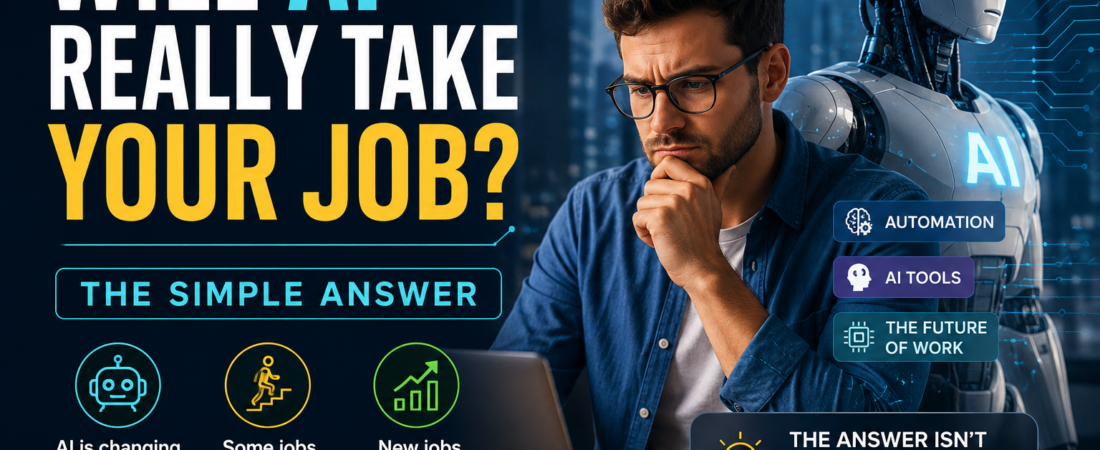
Ask ten people whether AI will take your job and you’ll get ten confident answers — and roughly half of them will contradict the other half. That’s not because the people answering are careless. It’s because the honest answer to a yes-or-no question doesn’t fit in a yes-or-no box. Government labor data already shows AI-exposed jobs shrinking. The same period shows AI-adjacent jobs growing faster than almost anything else in the labor market. Both of those are documented, current, and true at the same time. This piece doesn’t pick a side. It lays out exactly what’s confirmed, what’s forecast, what’s opinion, and what’s still genuinely unknown, so you can tell which kind of claim you’re hearing next time someone gives you a confident one-word answer.

AI-generated illustration
What We Know (Fact)
Start with what’s actually measured, not predicted. The U.S. Bureau of Labor Statistics has flagged 18 occupations, covering about 10 million jobs, as most exposed to AI, and between May 2024 and May 2025 those occupations lost 0.2% of their employment while the overall U.S. job market grew 0.8%. Customer service representative roles fell 4.8% in that single year, about 130,000 jobs. Administrative and secretarial roles outside medicine, law, and executive offices fell 1.8%. The occupations that have shrunk the most since ChatGPT launched in late 2022 are credit authorizers and clerks, broadcast announcers, and sales engineers. Entry-level hiring has been hit hardest of all: a Harvard working paper tracking 66 million workers across more than 280,000 U.S. firms found that entry-level hiring at companies adopting generative AI has fallen roughly 80% per quarter since 2023. The Federal Reserve Bank of New York reported that by the end of 2025, unemployment among recent college graduates had climbed to 5.6%, with 42.5% underemployed, the highest underemployment rate since the pandemic. In 2025, companies publicly cited AI as a factor in about 55,000 layoffs, more than twelve times the number cited two years earlier; by March 2026, AI had become the single most-cited reason employers gave for cutting jobs. But the same period shows real growth on the other side of the ledger. LinkedIn’s own posting data ranks AI Engineer as the fastest-growing job title in the U.S., up 143% year-over-year, and postings requiring general “AI literacy,” not just specialist roles, grew more than 70% in a single year.

AI-generated illustration
What Analysts Forecast (Forecast)
Where the facts stop, forecasting begins, and forecasters disagree sharply with each other, which is itself informative. The World Economic Forum surveyed employers representing roughly 14 million workers worldwide and projects that by 2030, AI and related technologies will help create 170 million new roles while displacing 92 million existing ones, a net gain of 78 million jobs, alongside 22% total workforce churn as roles are created and eliminated faster than many workers can retrain between them. Goldman Sachs economists, in a widely cited analysis originally published in March 2023 and still being referenced in 2026 coverage, estimated that generative AI could eventually touch two-thirds of U.S. and European jobs to some degree and substitute for up to 25% of current work tasks worldwide, roughly 300 million full-time-equivalent jobs, while also projecting it could lift U.S. productivity growth by nearly 1.5 percentage points a year over a decade and add roughly 7% to global GDP. That forecast is now three years old and predates most of the entry-level hiring data above, so its specific numbers are worth treating as dated rather than current. At the more conservative end, MIT economist and 2024 Nobel laureate in Economics Daron Acemoglu forecasts that only about 5% of workplace tasks will be profitably automatable within the next decade, projecting a comparatively modest 1.1% to 1.6% cumulative GDP effect over that period, a fraction of Goldman’s estimate, built from very different assumptions about how quickly AI capability turns into real workplace deployment.
Image pending — a real photo of a small team reviewing charts, a whiteboard, or a planning document together in an office setting, forward-looking rather than triumphant or anxious in tone; see 08-ai-visual-plan.md.
What People Are Saying (Opinion)
The people building this technology don’t agree with each other either, and some don’t agree with their own past selves. In July 2025, OpenAI CEO Sam Altman told Federal Reserve officials that “some areas” of the job market, naming customer support specifically, would be “just like totally, totally gone” as AI agents took over. Ten months later, at a conference in Sydney in May 2026, Altman said something closer to the opposite about the broader picture: “I’m delighted to be wrong about this, I thought there would have been more impact on entry-level white-collar jobs being eliminated by now than has actually happened,” adding that he doesn’t expect “the kind of jobs apocalypse that some companies in our space advocate or talk about.” Same person, ten months apart, two different reads on the same trend. Acemoglu, beyond his numeric forecast above, has said plainly that the macroeconomic data so far shows no material impact on aggregate employment, and that he’s skeptical today’s “agentic” AI systems can yet handle the fluid task-switching that most real jobs actually require. Vanguard’s chief economist, Joe Davis, offers a different lens entirely: “we remain closer to the ATM phase than the mobile banking phase,” comparing today’s AI to the earliest, most literal stage of automation rather than the more mature, augmentation-focused stage that historically follows it.
What’s Still Speculative (Speculation)
Some of the most-repeated claims about AI and jobs aren’t confirmed facts or attributed forecasts, they’re plausible guesses dressed up with confidence. Whether AI follows the same pattern as the ATM did with bank tellers, where automating routine tasks ultimately created more jobs, not fewer, by making the underlying business cheaper to run, is a genuinely open question, not a settled one; the technology, the pace of rollout, and the tasks involved are different enough from 1970s-2000s branch banking that the analogy is suggestive, not predictive. It’s also unconfirmed whether the current entry-level hiring contraction is a permanent restructuring of how careers begin or a temporary pause while employers figure out how to use these tools responsibly, nobody has enough years of data yet to say which. And it’s unconfirmed whether the WEF’s and Goldman’s multi-year projections will hold at all, given how fast AI capability itself has moved even in the past two years; a forecast built on today’s tools can look stale within twelve months, as the aging Goldman number in this piece already shows.

AI-generated illustration
What This Means for You
None of this resolves into a single verdict, and that’s the honest headline: AI is already taking some jobs, specifically and documentably the routine, entry-level parts of many roles, while creating others, mostly technical and AI-adjacent, and the aggregate economy hasn’t collapsed either way. If you’re already established in a field, the immediate risk looks less like “your job disappears overnight” and more like “the routine parts of your job get automated and the parts requiring judgment, relationships, and ambiguity-handling become what you’re actually paid for,” which is close to what happened to bank tellers after the ATM. If you’re trying to enter a field, the risk is sharper and better documented: entry-level hiring is where the contraction is clearest right now, so building a portfolio of real, demonstrable work, not just credentials, matters more than it used to. Either way, the useful move isn’t panicking or dismissing the question; it’s asking your employer directly what their AI plans actually are, tracking which of your own tasks are genuinely repetitive versus genuinely judgment-based, and treating “AI literacy” as a real, data-backed skill worth building rather than a buzzword. The honest answer to “will AI take your job” is: parts of it, maybe already, and the parts that are left are the parts worth getting better at.