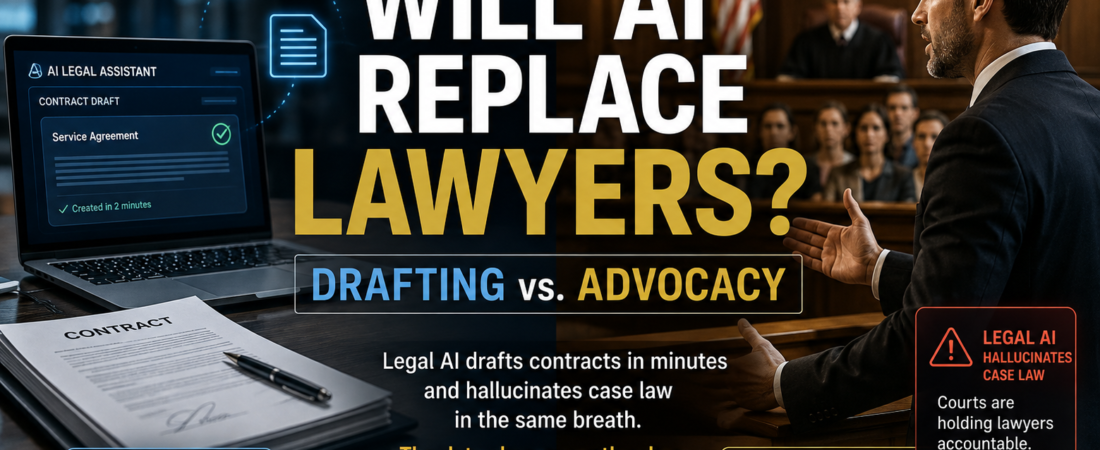
A federal judge in Mississippi sanctioned four lawyers this June for filing briefs that leaned on AI-hallucinated case law. Nine months earlier, a Sixth Circuit panel ordered two attorneys to personally pay $15,000 each, plus the opposing side’s full appellate legal bill, for the same underlying mistake. Both incidents happened in the exact stretch of time legal industry surveys show AI use becoming close to routine inside the largest firms.
Those two facts aren’t in tension. They’re the same story told from opposite ends of the job. “Lawyer” isn’t one task AI is or isn’t replacing — it’s two genuinely different layers of work, and the evidence shows AI moving fast through one of them while the other keeps generating court sanctions every time someone tries to skip it.
The Job Isn’t One Thing
Strip away the title and legal work splits into two layers that have almost nothing in common. One layer is production: drafting contracts, reviewing documents, researching case law, sorting discovery, summarizing depositions, checking a filing against the record. It’s repeatable, pattern-based, and — crucially — checkable against a right answer. The other layer is advocacy and judgment: standing in front of a judge or jury, counseling a client through a decision with real consequences, negotiating a settlement, deciding which argument actually wins a specific case in front of a specific decision-maker, and carrying personal, licensed responsibility for the outcome. It’s not pattern-based. There’s no dataset of “correct” advice for a client facing a choice only they can make.
Every serious source on legal AI adoption in 2026 draws the line in roughly the same place, even when they’re measuring different things: adoption is surging in the production layer and staying cautious, supervised, or absent in the advocacy layer.

What Law Firms Are Actually Using AI For
The clearest read on adoption comes from three independent surveys running in parallel. Thomson Reuters’ 2026 AI in Professional Services Report found 41% of law firms and 47% of corporate legal departments say their legal teams are using generative AI, up sharply from 28% and 23% just a year earlier — and the tools are concentrated in document review, legal research, and contract analysis, the report estimates could save lawyers close to 240 hours a year on routine work. Clio’s 2025 Legal Trends Report shows the same acceleration from a different angle: AI adoption at mid-sized firms jumped from 19% to 93% in a single year, and firms with wide AI adoption were nearly three times more likely to report revenue growth than firms that hadn’t adopted it. The American Bar Association’s own technology survey puts self-reported AI use among individual attorneys at 30.2%, rising to 47.8% at firms with 500 or more lawyers — and names ChatGPT, Thomson Reuters’ CoCounsel, and Lexis+ AI as the three most-adopted tools, in that order.
| Data point | Figure | Source |
|---|---|---|
| Law firms / corporate legal depts. using GenAI (2026, up from 2025) | 41% / 47% (up from 28% / 23%) | Thomson Reuters, 2026 AI in Professional Services Report |
| Mid-sized firm AI adoption, one-year change | 19% → 93% | Clio, 2025 Legal Trends Report |
| Attorneys reporting AI use, overall / at 500+-lawyer firms | 30.2% / 47.8% | American Bar Association, Legal Technology Survey Report |
| Legal orgs. using or piloting agentic AI | 15% using now, 53% planning/considering | Thomson Reuters, 2026 AI in Professional Services Report |
Governance hasn’t kept pace with any of that growth. More than half of legal professionals — 53%, per Clio — say their firm has no AI policy or they’re not aware of one, and Thomson Reuters found fewer than one in five firms currently measure AI’s return on investment at all. Fast, ungoverned adoption of a tool with a known accuracy problem is exactly the setup that produced this year’s sanctions cases.
[AI-ILLUSTRATION: A clean, editorial split-frame illustration — one side shows fast-moving document and contract icons flowing efficiently through a funnel labeled “drafting, research, review”; the other side shows a single courtroom podium with a human silhouette standing at it, deliberately still and detailed, representing the advocacy layer that resists automation.]
Why the Advocacy Layer Keeps Producing Sanctions
The accuracy gap is the whole story here, and it’s been measured directly. A pre-registered Stanford RegLab study tested general-purpose language models against legal queries and found hallucination rates between 58% (GPT-4) and 88% (Llama 2). More striking: the same study tested the commercial legal-research tools built specifically for lawyers — Lexis+ AI and Thomson Reuters’ Westlaw AI-Assisted Research and Ask Practical Law AI — and found they still hallucinated 17% to 33% of the time, despite marketing language from some vendors claiming their tools were “hallucination-free.” Westlaw’s AI-Assisted Research hallucinated at roughly twice the rate of Lexis+ AI in the study’s tests.
Courts are now the place where that gap becomes visible and expensive. In July 2025, two attorneys representing a defendant in Coomer v. Lindell were fined $3,000 each by a federal court in Colorado after filing a brief containing close to 30 defective citations, several to cases that don’t exist. In March 2026, a Sixth Circuit panel sanctioned two attorneys in Whiting v. City of Athens over more than two dozen fabricated citations, ordering $15,000 each to the court registry plus the opposing party’s full appellate fees across three appeals. In June 2026, a federal judge in the Northern District of Mississippi removed four lawyers from a case entirely after members of the team admitted to using AI to draft or research a filing — and, in at least two instances, to signing off on the result without checking the underlying sources. Multiple independent trackers have now catalogued hundreds of similar incidents worldwide, though the exact running count varies by tracker methodology and shouldn’t be treated as a single precise figure [UNVERIFIED — precise multi-tracker count].
The American Bar Association’s own ethics guidance treats this as a core professional-responsibility issue, not a technical footnote. Formal Opinion 512, issued July 29, 2024, holds that Model Rule 1.1’s duty of competence requires a lawyer using generative AI to have “a reasonable understanding of the capabilities and limitations” of the tool — they don’t need to become AI experts, but they can’t outsource the checking. The same opinion also addresses confidentiality (Rule 1.6), candor toward the court (Rules 3.1 and 3.3), and a supervising lawyer’s responsibility for AI output produced by anyone under their direction (Rules 5.1 and 5.3). Every sanctions case above is, functionally, a violation of that standard: the tool drafted something plausible-sounding, and a licensed human being was supposed to catch what it got wrong before signing their name to it. When that check happened, the failure never reached a courtroom. When it didn’t, it became case law about AI failure instead of the client’s actual case.

What the Labor Market Actually Shows
This is where lawyers’ situation looks different from several other “will AI replace X” professions. The U.S. Bureau of Labor Statistics projects lawyer employment to grow 4% from 2024 to 2034 — from 864,800 jobs to about 900,700, roughly in line with the 3% average across all occupations — with about 31,500 openings projected per year. But unlike some other white-collar occupations BLS covers, its own stated reasoning for this occupation explicitly names automation as a live factor, not just demographics or budgets: BLS’s Job Outlook narrative states that “more price competition … may lead law firms to rethink project staffing to reduce costs” and that “some routine legal work may be automated or outsourced to low-cost legal providers.” That’s a direct, primary-source acknowledgment that the production layer of legal work is genuinely exposed — the same layer the adoption data above shows firms already routing to AI.
Goldman Sachs’ March 2023 economic-growth research estimated legal work among the occupations with the highest share of tasks exposed to generative AI automation potential, on the order of 44% of tasks — an estimate of task exposure, not job loss, and one the bank hasn’t since restated with equivalent precision [FORECAST — Goldman Sachs Global Investment Research, March 2023; more recent secondary recalculations exist but are third-party estimates, not a directly restated Goldman figure, and are treated here as unverified]. On the ground, legal-recruiting analysts report the practical version of that exposure: first-pass review of a standard NDA or commercial agreement that used to take a junior associate two to three hours can now be completed in under 15 minutes with AI tools, and some firms are hiring fewer entry-level associates in favor of experienced lateral hires who can already work productively alongside these tools [OPINION/TREND ANALYSIS — legal-recruiting industry reporting, not an official labor survey].
Put together: the aggregate job count for “lawyer” isn’t shrinking — it’s still growing roughly in line with the rest of the economy, and BLS attributes most of the churn in it to ordinary retirement and career transitions. What’s shifting is the shape of the entry point into the profession, concentrated in exactly the production-layer tasks the adoption surveys above show AI already handling.

What This Means If You’re a Lawyer — Or Becoming One
Not “avoid AI” — the productivity data argues strongly against that, and firms not using it are already reporting weaker revenue growth than firms that are. The actionable distinction is which layer of the job you’re trusting it with. For drafting, first-pass research, and document review, the tools are fast, genuinely useful, and increasingly expected — Formal Opinion 512 assumes competent lawyers will use them. For anything that becomes the actual basis of a filing, an argument, or advice a client will rely on, the verification step isn’t optional busywork to skip when you’re behind — it’s the entire professional duty the sanctions cases above show what happens when it’s skipped. For anyone earlier in their career, the practical read isn’t that entry-level legal work is disappearing; it’s that the easiest version of it — the version that used to be how junior lawyers learned the trade by doing volume — is being compressed, which makes deliberately building the harder-to-automate skills (courtroom judgment, client counseling, negotiation) a genuine head start rather than a “someday” skill.
[AI-ILLUSTRATION: A simple, warm editorial illustration of two hands — one holding a stylized document with AI-generated draft text visible, the other a pen — meeting at a signature line, representing the human verification step that legally and ethically has to happen before an AI-assisted document becomes final.]
The Bottom Line
AI isn’t replacing lawyers. It’s rapidly taking over the production layer of legal work — drafting, research, first-pass review — while advocacy, judgment, and the professional responsibility that comes with a law license stay stubbornly, measurably human, not because AI has failed to reach them but because the cost of trusting it there shows up immediately, in a signed filing, with a named lawyer’s bar number attached. The labor-market numbers back up the same split: aggregate demand for lawyers keeps growing, but the entry-level version of the job — the volume production work AI now does faster — is visibly being reshaped. The real story isn’t a robot standing up in court. It’s a profession where the tool got very good at one half of the job, and every incident where someone forgot the other half is now a matter of public record.
Image Credits
- Visual 1 — Photo by Pavel Danilyuk on Pexels (Pexels License, free to use).
- Visual 2 — Photo by khezez on Pexels (Pexels License, free to use).
- Visual 3 — Photo by Pavel Danilyuk on Pexels (Pexels License, free to use).