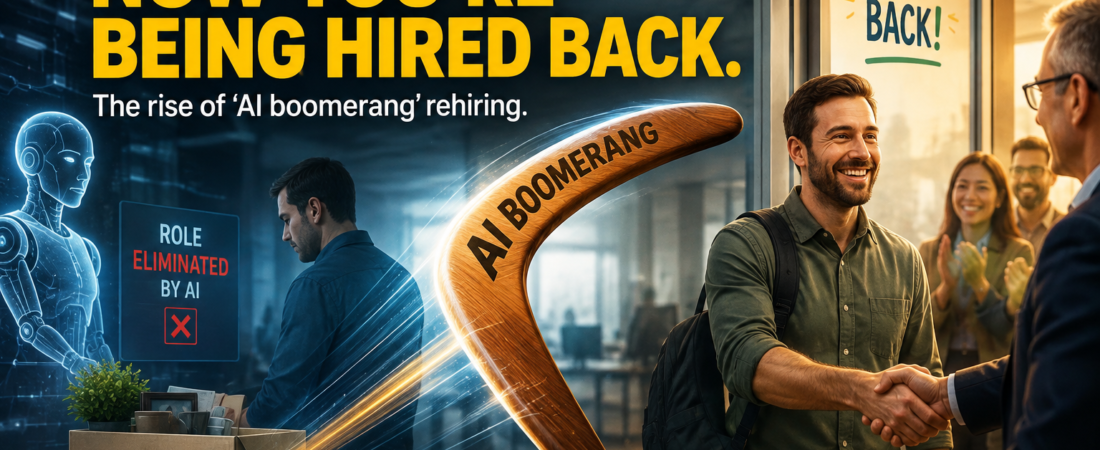
Ford spent the past three years hiring back the very kind of engineers its AI-driven quality-control system was supposed to make unnecessary — about 350 of them, brought back after automated inspection missed design and quality defects that experienced staff would have caught. It isn’t an isolated embarrassment. According to a Robert Half survey of more than 2,000 US hiring managers, nearly a third — 32% — say their company eliminated a role primarily because of AI, then later rehired for that exact position. Forrester, one of the most-cited analyst firms in the industry, now predicts that more than half of all layoffs attributed to AI will eventually be quietly reversed. Call it the “AI boomerang”: companies cut a role in the name of AI efficiency, discover what the role actually did, and pay to bring it back.
What Happened
Four independently reported cases, each cut for a different reason, show the pattern isn’t limited to one industry or one kind of job. Ford’s vice president of vehicle hardware engineering, Charles Poon, told Bloomberg the company “mistakenly” believed that feeding its design requirements into AI tools alone would produce a high-quality product — many of its most experienced engineers had already left before their knowledge could be used to train the systems replacing them. Klarna publicly claimed in February 2024 that an OpenAI-powered assistant was doing the work of 700 customer-service agents; CEO Sebastian Siemiatkowski later admitted “we went too far,” acknowledging that the aggressive cut eroded service quality and customer trust, and the company has since rebuilt a blended human-and-AI support model. Commonwealth Bank of Australia cut 45 customer-service roles for an AI “voice bot” it said would reduce call volume by roughly 2,000 calls a week — call volumes reportedly rose instead, the bank’s own spokesperson acknowledged the roles “were not redundant,” and CBA apologized and reversed the cuts. IBM took a different path entirely: its AskHR system already resolves about 94% of routine HR queries, but instead of using that number to justify deeper cuts, CHRO Nickle LaMoreaux announced IBM would triple its US entry-level hiring in 2026 — reasoning that skipping entry-level hiring now just means paying more to poach mid-level talent from competitors in three to five years.
| Company | What Was Cut or Automated | What Happened Instead | Source |
|---|---|---|---|
| Ford | AI-driven design/quality inspection | Rehired ~350 veteran engineers over 3 years; topped J.D. Power’s 2026 Initial Quality Study | Bloomberg, TechCrunch, Forbes (June 2026) |
| Klarna | ~700 customer-service roles, AI assistant | CEO admitted “we went too far”; rebuilding blended human/AI support | Widely corroborated, incl. Bloomberg’s original reporting |
| Commonwealth Bank of Australia | 45 customer-service roles, AI voice bot | Reversed cuts, apologized, acknowledged roles “were not redundant” | TechRadar Pro (Aug 2025) |
| IBM | N/A — proactive, not a reversal | Tripling US entry-level hiring in 2026 despite AskHR resolving 94% of queries | IBM (ibm.com/think), Axios, TechCrunch (Feb 2026) |
Why It Matters

These four cases aren’t outliers — they match what two separate surveys found across thousands of employers. Robert Half’s April 2026 survey found rehiring rates highest in finance (44%), HR (35%), and tech (32%), with the top reasons being that a role required institutional knowledge AI couldn’t replace (40%), productivity gains came in smaller than expected (35%), and AI needed more human oversight than anticipated (38%). Separately, a Careerminds survey of 600 HR professionals whose organizations laid off staff for AI in the prior year found about two-thirds had already rehired some of those employees, and 90% said they’d rethink aspects of the layoffs if given the chance. For context on just how far above normal this is: workforce-analytics firm Visier’s analysis of 2.4 million employees across 142 companies puts the overall rehire rate after any layoff, for any reason, at roughly 5.3% — meaning AI-linked rehiring is running several times above the general baseline.
| Source | What It Found | Sample |
|---|---|---|
| Robert Half (Apr 2026) | 32% of hiring managers rehired for a role cut due to AI | 2,000+ US hiring managers |
| Careerminds (early 2026) | ~2/3 of AI-laying-off companies rehired some staff | 600 HR professionals |
| Visier (baseline) | ~5.3% overall rehire rate after any layoff, any cause | 2.4M employees, 142 companies |
| Gartner (Oct 2025 survey) | Only 20% of customer-service leaders actually cut staff for AI | 321 CS/support leaders |

AI-generated illustration
It’s worth being precise about what this data does and doesn’t show. Gartner’s own October 2025 survey of 321 customer-service leaders found that only 20% had actually reduced staff because of AI at all — most report steady headcount even while supporting more customers. Gartner analyst Kathy Ross put it directly: “Most recent workforce reductions were influenced by broader economic conditions rather than automation alone.” That’s the same caution Forrester raises under the term “AI washing” — many companies announcing AI-related layoffs, per Forrester’s own research, don’t actually have a mature, vetted AI system ready to fill the gap; the AI label sometimes explains a cut that was really about the balance sheet.
What’s Next
Two of the industry’s most-cited analyst firms are now making the boomerang pattern an explicit forecast rather than a collection of anecdotes. Forrester’s own January 2026 prediction states plainly that “over half of layoffs attributed to AI will be quietly reversed as companies realize the operational challenges of replacing human talent prematurely.” Gartner goes further with a number and a date: by 2027, the firm predicts, half of companies that cut customer-service staff for AI will rehire — often, notably, “under different job titles,” which is its own quiet admission that the job didn’t actually disappear. Gartner’s Emily Potosky was blunt about why: “AI simply isn’t mature enough to fully replace the expertise, empathy, and judgment that human agents provide. Relying solely on AI right now is premature and could lead to unintended consequences.”
For employers, the practical lesson isn’t “don’t use AI” — it’s “know what you’re actually cutting before you cut it.” Adecco Group CHRO Daniela Seabrook, whose team surveyed 2,000 C-suite executives across 13 countries, argues the fix has to happen before the layoff, not after: ask which tasks in a role are genuinely automatable, what happens to the rest of the role if only part of it is, what expertise disappears if the role goes entirely, and whether redesigning or redeploying the role beats eliminating it outright. Her own data shows why that discipline is rare — only 36% of leaders say their AI strategy clearly creates opportunity for employees, and just 22% feel confident their organization is building future-ready skills at all.

AI-generated illustration
For workers, the data suggests boomeranging back is increasingly normal, not a step down. A MyPerfectResume survey of more than 1,000 US workers found 55% now consider returning to a former employer a “smart career move,” against just 5% who see it as a failure — but the same survey found 98% say how they were let go the first time matters to whether they’d say yes to a rehire, and more than 70% say any re-recruitment has to be handled with visible respect. Visier’s data backs up who actually gets the call: high performers return at a 120% higher rate than average, managers at a 68% higher rate than individual contributors, and staff with 10-15 years of tenure at a 42% higher rate than other tenure groups — the same institutional-knowledge profile Ford’s Poon described losing. Boomerang hires also tend to come back with real leverage: an average 5% pay increase, versus 2% for employees who never left.
The Bottom Line
The companies now quietly rehiring for roles they cut in AI’s name aren’t proof that AI doesn’t work — Gartner’s own numbers show most employers haven’t actually reduced headcount for AI at all, and Ford’s, Klarna’s, and CBA’s own explanations point to a narrower failure: cutting judgment, institutional knowledge, and relationship-dependent work before AI could genuinely absorb it, not AI failing across the board. The boomerang pattern is really a measurement of which parts of a job a company didn’t understand it needed, until the job was gone. For employers, that’s a case for slowing the decision down before the layoff, not after. For workers, it’s a reason to treat “AI replaced my job” headlines with the same skepticism this piece just applied to them — and to know that saying yes to a rehire offer is, per the data, no longer read as a step back.
Sources & References
- Fast Company, “The ‘AI boomerang’: Why some companies are rehiring employees they laid off due to AI,” June 5, 2026 — https://www.fastcompany.com/91554983/ai-boomerang-why-some-companies-are-rehiring-employees-they-laid-off
- HR Executive, “As AI layoff regret surges, will boomerang employees make a comeback?,” April 21, 2026 — https://hrexecutive.com/as-ai-layoff-regret-surges-will-boomerang-employees-make-a-comeback/
- HR Executive, “Ford’s rehire wave has HR leaders rethinking how AI layoffs get decided,” July 24, 2026 — https://hrexecutive.com/fords-rehire-wave-has-hr-leaders-rethinking-how-ai-layoffs-get-decided/
- Forrester, official press release, “Forrester: AI-Led Job Disruption Will Escalate, While Fears Of A Job Apocalypse Are Overstated,” January 13, 2026 — https://www.forrester.com/press-newsroom/forrester-impact-ai-jobs-forecast/
- Gartner, official press release, “Gartner Predicts Half of Companies That Cut Customer Service Staff Due to AI Will Rehire by 2027,” February 2, 2026 — https://www.gartner.com/en/newsroom/press-releases/2026-02-03-gartner-predicts-half-of-companies-that-cut-customer-service-staff-due-to-ai-will-rehire-by-2027
- TechRadar Pro, “Now that’s an embarrassing U-turn — bank forced to rehire human workers after their AI replacement fails to perform,” August 22, 2025 — https://www.techradar.com/pro/now-thats-an-embarassing-u-turn-bank-forced-to-rehire-human-workers-after-their-ai-replacement-fail-to-perform
- IBM, “The bottom rung returns as AI reshapes entry-level jobs” — https://www.ibm.com/think/news/entry-level-roles-get-reset-ai
- Axios, “IBM plans to triple entry-level hiring this year because of AI,” February 13, 2026 — https://www.axios.com/2026/02/13/ai-ibm-tech-jobs
- TechCrunch, “IBM will hire your entry-level talent in the age of AI,” February 12, 2026 — https://techcrunch.com/2026/02/12/ibm-will-hire-your-entry-level-talent-in-the-age-of-ai/